
Aktau
Kazakhstan's Caspian port, built as a closed Soviet uranium city and now the gateway to the Mangystau desert.
Explore attraction → Explorer Bulletin
Documenting remote trails and global journeys
The largest landlocked country on Earth: steppe without end, the red sandstone Valley of Castles, and a Caspian coastline of chalk mesas facing Azerbaijan.
Kazakhstan is the largest landlocked country on Earth, and the ninth largest overall — bigger than all of Western Europe combined, with a population smaller than that of the Netherlands. Most of it is steppe: an ocean of grass that runs for thousands of kilometres without meeting a mountain range. But the edges are where the country gets strange and specific.
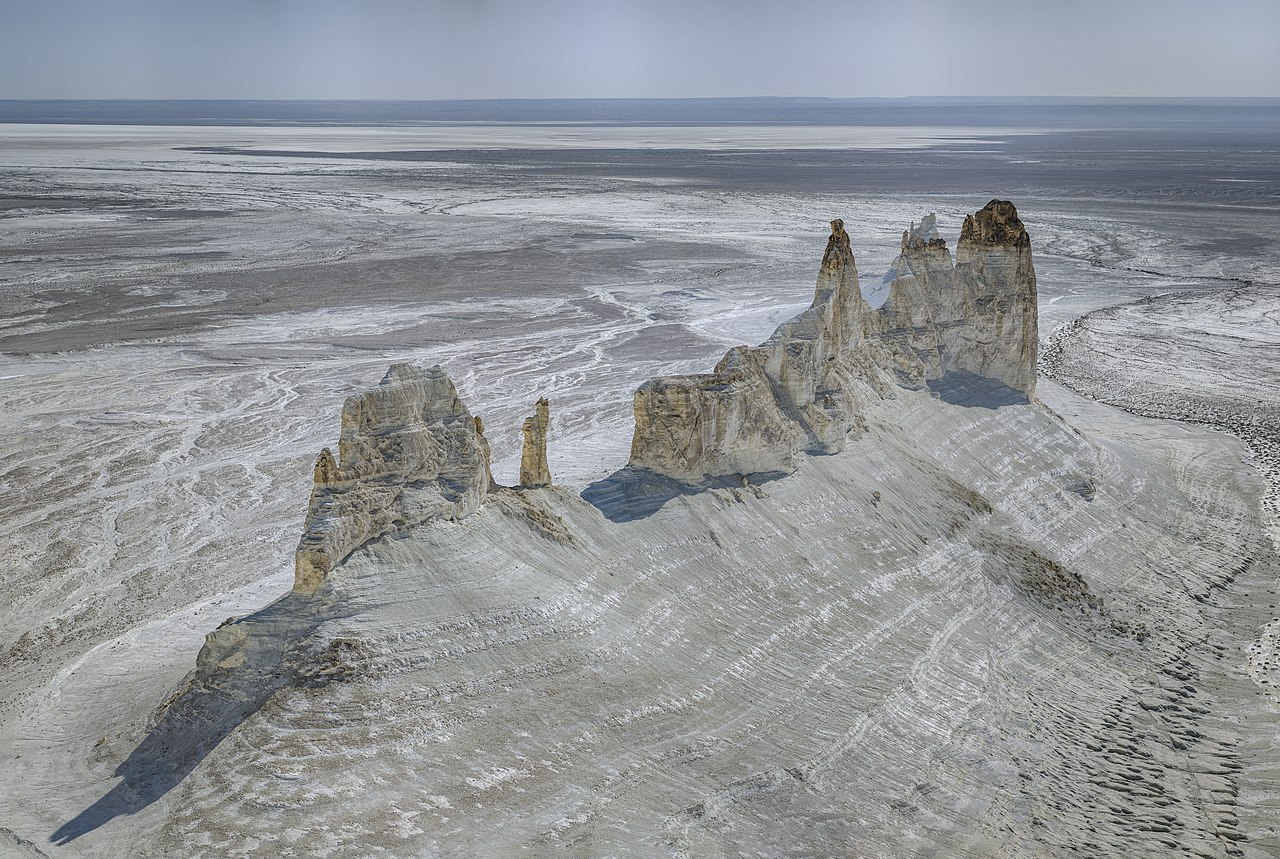
In the southeast, near the Chinese border, the Charyn River has cut a red sandstone canyon whose weathered columns have earned it the nickname the Valley of Castles. Further west, past the Aral Sea's dry bed, the Mangystau region runs out to the Caspian in a landscape of chalk mesas and eroded limestone that looks less like Central Asia than like the surface of another planet.
And Kazakhstan is a Caspian country. Its western shore, anchored by the port city of Aktau, faces Azerbaijan across roughly 400 kilometres of water — a crossing that carries both a working freight corridor and an infrequent passenger ferry, and which makes Kazakhstan one of the five states that have spent decades negotiating what the Caspian legally is.
The continental climate is unforgiving at both ends: summers on the steppe push past 40°C and winters routinely drop below −20°C. Late April to early June and September to mid-October are the reliable windows, when the canyons are walkable and the desert is survivable.
Kazakhstan's Caspian port, built as a closed Soviet uranium city and now the gateway to the Mangystau desert.
Explore attraction →
Chalk mesas and twin limestone pinnacles rising from the floor of a former seabed in Kazakhstan's Mangystau desert.
Explore attraction →
A 90 km red sandstone gorge in southeast Kazakhstan, whose eroded columns give the Valley of Castles its name.
Explore attraction →