
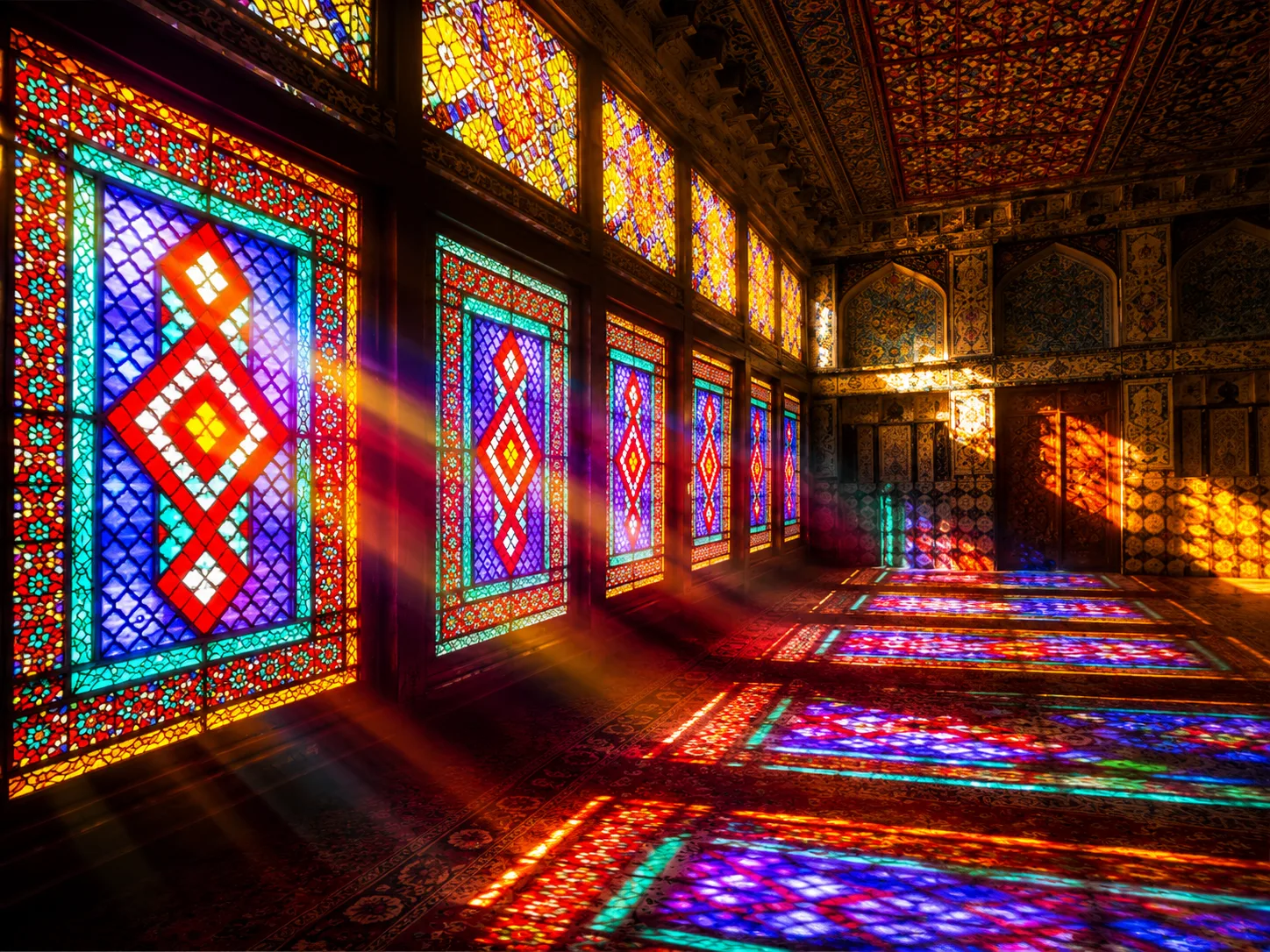
A Window Assembled Like a Puzzle
Stand inside the Palace of the Sheki Khans on a bright morning and the room does something unusual: it throws colour. Light comes through tall lattice windows and lands on the floor and walls as a shifting grid of red, cobalt and green. The windows are the reason most visitors climb the hill to the palace, and the reason the building is on the UNESCO World Heritage List.
The technique is called shebeke (şəbəkə in Azerbaijani, from the Arabic for "net" or "mesh"). Each window is a lattice of small hardwood bars holding hundreds of pieces of coloured glass. What makes it remarkable is what is missing: there are no nails, no screws and no glue anywhere in the frame.
How It Is Made
A shebeke craftsman cuts the wooden bars — usually oak, sometimes walnut — and notches each one so it interlocks with its neighbours. The pieces are assembled dry, one at a time, and the glass is slotted into the gaps as the lattice grows. When the last bar goes in, the whole panel tightens against itself. Friction and geometry do the work that fasteners would do in a conventional window.
The density is what surprises people. A single square metre of palace shebeke is often cited as containing several thousand separate pieces of wood and glass. The coloured glass itself was historically imported — Venetian glass travelled a long way east to end up in a Caucasian foothill town, which tells you something about how well connected Sheki once was.
Why Build a Window This Way?
There is a practical argument: wood expands and contracts with heat and humidity, and a rigidly fastened panel of this complexity would crack. A dry-assembled lattice can move. Panels can also be taken apart and repaired piece by piece rather than replaced — useful for a building that has stood since the late eighteenth century.
And there is the obvious argument: it is beautiful, and it was meant to be. The palace was a summer residence, built to impress visitors. The windows are the flourish.
The Craft Is Not a Museum Piece
Shebeke did not stop when the khans did. A small number of workshops in Sheki still build these windows by hand, for restoration work and for private commissions, and the training still happens the old way — by sitting next to someone who already knows how. It is slow, and the workshops are easy to walk past on the street below the palace, but the craft is alive rather than preserved.
Seeing It
The Khan's Palace is the showpiece, and its upper-floor windows are the ones that end up in photographs. There is more shebeke in the town than the palace alone, though: several of the merchant houses and the caravanserais use the same latticework, usually in plainer form. Sheki sits about 300 km north-west of Baku, in the wooded foothills of the Greater Caucasus, and the town is small enough to cover on foot once you are there.
Getting to Sheki from Baku
Sheki is a long day from the capital — roughly four hours each way. Tourister keeps a running comparison of the day trips that make the journey.
Compare day trips from Baku
Discussion (0)